
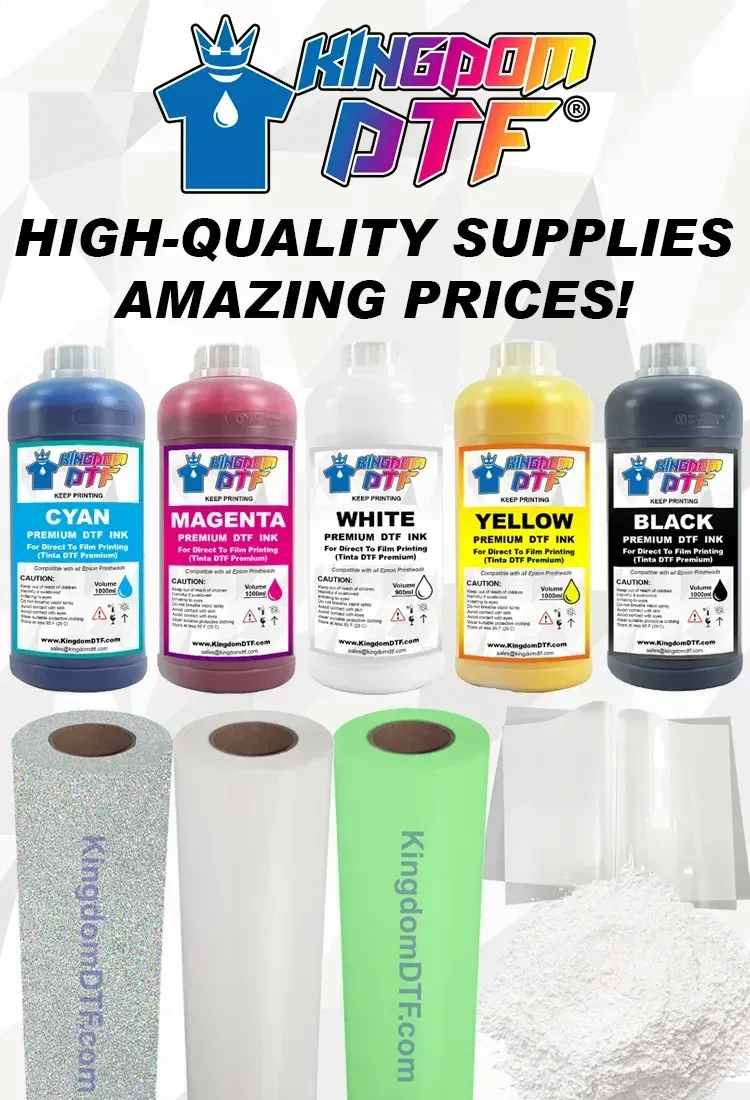
DTF supplies guide is a practical, customer-focused resource designed to help you navigate direct-to-film printing with confidence. This guide walks you through the core components—DTF inks, DTF films, and DTF powders—and explains how to evaluate each category so you can assemble a reliable, cost-effective setup of direct-to-film printing supplies. Whether you’re a small shop expanding into wearable printing or a seasoned producer seeking better yield and consistency, the right combination of inks, films, and powders makes the difference between mediocre results and vibrant, durable prints. In this guide, we’ll cover what to look for in DTF inks, how to choose the best DTF films, the role of DTF powders, and practical buying tips to help you compare suppliers, manage costs, and avoid common pitfalls, including guidance on DTF transfer media. By the end, you’ll have a clear framework to navigate the market and build a robust DTF workflow that aligns with your production goals.
Viewed from another angle, the discussion centers on colorants for film transfer, carrier sheets, and adhesive powders—the core consumables that shape print quality. Different brands offer ink sets with varying color management, substrate compatibility, and wash durability, so evaluating colorfastness and profile data remains essential. The choice of transfer carriers, along with the heat-press schedule and substrate type, determines how clearly details reproduce and how the final hand feel reads. Understanding terms like transfer media, pigment formulations, and bonding powders helps you compare suppliers without getting lost in brand-specific jargon.
DTF Inks: Color, Longevity, and Printer Compatibility
DTF inks form the color foundation of direct-to-film prints, influencing color accuracy, brightness, and wash durability. When evaluating DTF inks, look for stable pigment chemistry, wide color gamut potential, and compatibility with your printer model and white-ink capabilities. A well-matched ink set—often CMYK plus white—helps you achieve sharp details and smooth gradations across a variety of transfer films and powders.
Beyond the lab, consider odor, VOC content, and maintenance needs, since low-odor formulations can improve comfort in small shops or on-site production. Emphasize nozzle health, clog resistance, and reliable substitution compatibility with your specific printer architecture to minimize downtime and ensure consistent outputs across runs.
DTF Films: Transfer Fidelity, Substrate Compatibility, and Film Selection
DTF films act as the carrier for your artwork and directly influence transfer fidelity, color saturation, and the final hand feel on fabrics. Key film attributes include thickness, clarity, and surface finish, which determine how well ink sits and transfers through the adhesive powder. White-on-dark versus clear-on-light workflows require different film types to preserve opacity, color accuracy, and edge sharpness.
When selecting DTF films, align film choice with your typical substrates—cotton, poly blends, or polyester—and your heat-press parameters. If you print high-detail images or smooth gradients, ensure the film surface promotes crisp reproduction of fine lines while minimizing residue after transfer. In some cases, bundled films with compatible adhesives can simplify setup and improve overall yield.
DTF Powders: Adhesion, Particle Size, and Process Windows
DTF powders complete the transfer by providing the adhesive layer that fuses ink to fabric during heat pressing. Powder performance hinges on consistent particle size, even coating, and reliable melting behavior, which collectively determine bonding strength and wash durability. Adhesive powders should bond across fabrics while preserving softness and color vibrancy after multiple washes.
Consider practical operating windows, including recommended pressing temperatures, dwell times, and powder coat thickness. Shelf life, storage conditions, and application consistency also impact results. To support diverse fabrics—cotton, blends, synthetics—select powders optimized for each fabric family and ensure compatibility with your chosen films and heat-press setup.
Direct-to-Film Printing Supplies: Optimizing Workflow with Transfer Media
Direct-to-film printing supplies encompass inks, films, and powders working together to form a reliable workflow. The right combination of DTF inks, DTF films, and DTF powders can dramatically improve transfer efficiency, color fidelity, and durability. This broader category—often termed direct-to-film printing supplies—emphasizes compatibility and predictability from ink deposition through film transfer and powder bonding.
Leverage a cohesive system by validating each component’s performance with your printer, heat press, and typical fabrics. Consider the role of DTF transfer media in your setup, and ensure that the chosen films and powders synchronize with the ink chemistry to minimize misregistration, edge cracking, or adhesive settling during production.
DTF Supplies Guide: A Framework for Evaluating Inks, Films, and Powders
DTF supplies guide offers a practical framework for evaluating the core components—DTF inks, DTF films, and DTF powders—and how they interact within a given workflow. Look for documented compatibility data, test results, and recommended process parameters that cover color stability, wash durability, and abrasion resistance across common fabrics. A structured guide helps you compare suppliers and avoid costly mismatch scenarios.
When buying, prioritize total cost per print by accounting for ink consumption, film usage per sheet, and powder usage per transfer, including waste and rework. Real-world data such as wash tests and long-term color stability from suppliers, plus pilot runs on representative garments, can validate end-to-end performance before you commit to larger purchases.
Quality Control and Profiling: Ensuring Consistency Across Batches
A robust DTF workflow relies on ongoing calibration and profiling to maintain color accuracy and adhesion across lots. Invest in ICC profiles or device-specific color management strategies that pair with your chosen DTF inks, films, and powders. Regularly print calibration sheets and verify alignment with target colors to minimize drift during production.
Implement simple pilot testing for new batches, monitor wash durability and abrasion resistance, and document lot-to-lot variability. By establishing repeatable test routines and referencing reliable performance data, you can reduce reprints, waste, and downtime while sustaining consistent finishes on every garment.
Frequently Asked Questions
In the DTF supplies guide, how do DTF inks, DTF films, and DTF powders work together to determine print quality and durability?
The guide explains that inks, films, and powders must be compatible with your printer and heat-press setup. A matched ink set provides color accuracy and stability, while the film quality affects transfer fidelity. The powders influence adhesion and wash durability; together they yield crisp details, strong bonding, and long-lasting prints across fabrics.
What should I look for in DTF inks according to the DTF supplies guide to ensure color accuracy and wash durability?
Key factors include stable pigment chemistry, wash-fastness, low odor, and compatibility with your printer. The guide recommends considering color gamut, gray balance, nozzle health, and available ICC profiles that match your films and powders. This helps minimize clogging and produce consistent results across runs.
When evaluating DTF films as described in the DTF supplies guide, what factors matter most for dark fabrics and high-detail prints?
Focus on thickness (mils), clarity, and surface finish; white-on-dark vs clear-on-light workflows influence opacity and color accuracy. Choose films that match your substrate and heat-press parameters, and verify that the film promotes crisp reproduction of fine lines.
How does the DTF supplies guide advise choosing DTF powders to match different fabrics and pressing conditions?
Look for adhesive strength and wash durability appropriate for cotton, blends, and synthetics, along with particle size and melting behavior that ensure even bonding. Consider the recommended pressing temperature and time, powder coat thickness, and how forgiving the system is to fabric variability.
What framework does the DTF supplies guide provide for evaluating direct-to-film printing supplies across inks, films, and powders?
The framework emphasizes compatibility across components, real-world performance data, and lot-to-lot consistency. It also covers cost per print, availability, and the quality of supplier documentation and support.
What buying tips from the DTF supplies guide help avoid common mistakes when purchasing DTF transfer media?
Request samples and technical data sheets, run small pilot tests, and print calibration sheets when trying new inks or films. Avoid mixing brands, monitor storage conditions, and prioritize supplier support and clear lead times.
| Section | Key Points |
|---|---|
| Inks | DTF inks impact color accuracy, wash durability, and compatibility with printers and DTF powders. Look for stable pigment chemistry, broad color gamut, low odor, good wash-fastness, reliable substitution compatibility with your printer model, and availability of CMYK plus white ink sets; consider printer profiles and maintenance to minimize clogs. |
| Films | DTF films affect print fidelity, transfer efficiency, and final feel. Key factors include thickness, clarity, surface finish, and compatibility with substrate type (cotton, blends, polyester). White-on-dark vs clear-on-light choices, heat and dwell time implications, and bond with the chosen powders matter. |
| Powders | Powders are the adhesive that binds prints to fabric. Consider adhesive strength and wash durability, particle size and distribution, temperature and dwell-time compatibility, fabric compatibility (cotton, blends, synthetics), and shelf life/storage conditions. |
| Framework for evaluating DTF supplies | A practical framework covers compatibility across inks, films, and powders; performance under real-world conditions; lot-to-lot consistency; cost per print; supplier availability and lead times; and support/documentation to aid troubleshooting. |
| Other essential supplies and tips | Pretreatment, curing aids, tapes, protective sheets, and heat mats help consistency. Include cleaning and maintenance, storage controls to preserve shelf life, and calibration/profiling to standardize color across fabrics and films. |
| How to compare suppliers | Request samples and technical data sheets, compare per-print costs (ink liters, film sheets, powder grams) including waste, run small pilot projects, and validate real-world wash durability and color stability. |
| Buying tips and common mistakes | Avoid mixing brands, don’t overstock one component, always print a calibration sheet, store carefully, and prioritize supplier support for setup, troubleshooting, and optimization. |
Summary
DTF supplies guide is a practical resource for building a reliable direct-to-film workflow by selecting compatible inks, films, and powders. It explains how each component affects color, adhesion, and durability, and provides a framework for evaluating suppliers, testing workflows, and profiling for consistent results. By focusing on ink performance, film compatibility, and powder bonding, you can achieve crisp artwork, strong wash resistance, and reliable results across orders. With careful supplier evaluation, testing, and ongoing profiling, your direct-to-film workflow becomes more efficient, cost-effective, and scalable for growing demand.